Every used car has a story. The VIN is where that story begins.
That 17-character code stamped on your dashboard isn’t random. It’s a standardized record of exactly what your vehicle is, where it was built, when it was made, and which specific unit rolled off the assembly line. Understanding what those characters mean — and knowing how to check what they reveal — is one of the most practical skills any used car buyer can have.
Here’s a complete breakdown of VIN number meaning, how each section works, and what you can learn from a vehicle’s VIN before you ever run a history report.
What Is a VIN Number on a Car?
A Vehicle Identification Number (VIN) is a unique 17-character code assigned to every vehicle at the time of manufacture. No two vehicles in the world share the same VIN — it functions as the vehicle’s permanent fingerprint, following it from the assembly line through every owner, registration, accident, and title transfer.
VINs were standardized internationally in 1981. Every vehicle manufactured for sale since then follows the same 17-character format governed by ISO Standard 3779 and NHTSA regulations. Vehicles manufactured before 1981 used shorter, non-standardized identification numbers that varied by manufacturer.
The VIN alphabet uses numbers 0-9 and letters A-Z, with three deliberate exclusions: the letters I, O, and Q are never used in any VIN position. This prevents confusion with the numbers 1 and 0, which look nearly identical in many fonts.
Where to Find the VIN on a Car
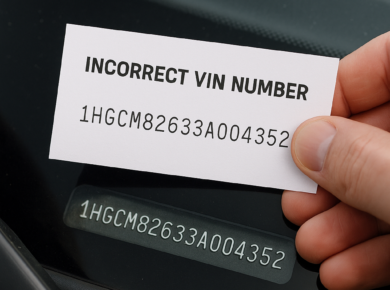
The VIN appears in multiple locations on every vehicle. For verification purposes — especially when buying used — always confirm that the VIN in every location matches.
Primary locations:
- Dashboard plate — visible through the windshield from outside the vehicle, lower-left corner of the dash on the driver’s side
- Driver-side door jamb — on the certification label sticker, which also shows tire pressure and weight ratings
Secondary locations (for cross-reference):
- Title and registration documents
- Insurance card
- Engine block (stamped, not labeled)
- Frame rail (on trucks and larger vehicles)
If the VIN in any location doesn’t match the others — even by one character — investigate before proceeding with a purchase. Mismatched VINs are one of the primary indicators of VIN tampering or fraud.
Breaking Down the VIN: Three Sections, 17 Characters
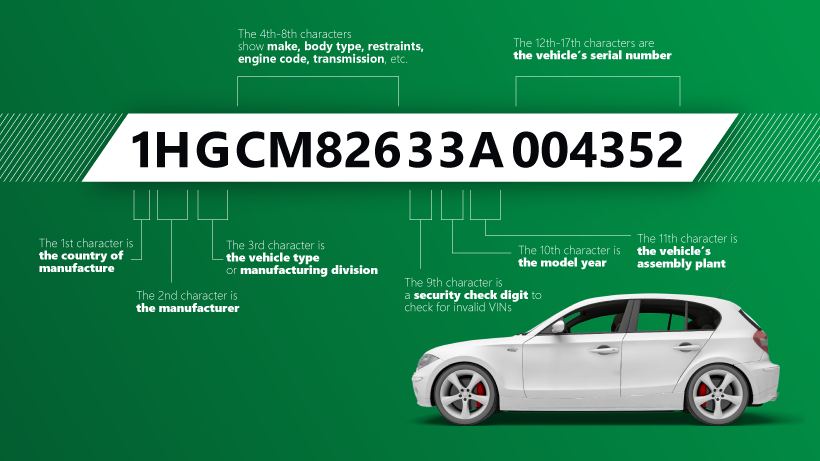
Every VIN is divided into three distinct sections, each serving a specific purpose.
Section 1: WMI — World Manufacturer Identifier (Characters 1–3)
The first three characters tell you where the vehicle was made and by whom.
Character 1 — Country of Assembly
| Code | Country |
|---|---|
| 1, 4, 5 | United States |
| 2 | Canada |
| 3 | Mexico |
| J | Japan |
| K | South Korea |
| L | China |
| S | United Kingdom |
| W | Germany |
| Y | Sweden or Finland |
| Z | Italy |
Character 2 — Manufacturer
The second character identifies the manufacturer within that country. This character’s meaning varies by country and brand — the same letter can represent different manufacturers in different countries.
Common U.S. examples:
1G= General Motors (USA)1F= Ford (USA)1C= Chrysler/RAM/Jeep (USA)1H= Honda (USA plant)1N= Nissan (USA plant)4T= Toyota (USA plant)
Character 3 — Vehicle Type or Division
The third character, combined with the first two, specifies the vehicle type or manufacturing division.
Real examples:
1FT= Ford truck, United States1G1= Chevrolet passenger car, United States1GC= Chevrolet truck, United StatesWDB= Mercedes-Benz, GermanyJHM= Honda, JapanKM8= Hyundai SUV, South Korea
Section 2: VDS — Vehicle Descriptor Section (Characters 4–9)
Characters 4 through 9 describe the specific vehicle — its model, body style, engine, and transmission — plus one critical security character.
Characters 4–8: Vehicle Attributes
These five characters encode the vehicle’s specific configuration. The exact meaning of each position varies by manufacturer — each automaker defines their own VDS coding system within the NHTSA framework.
Common attributes encoded in this section:
- Body style (sedan, coupe, SUV, pickup, wagon)
- Engine type and displacement
- Transmission type
- Restraint system (airbag configuration)
- Series or trim level
Real example — decoding a Ford F-150 VDS: A 2021 Ford F-150 with VIN beginning 1FTFW1E5...:
F(position 4) = F-Series truckW(position 5) = SuperCrew cab1(position 6) = 4×2 drivetrainE(position 7) = 2.7L EcoBoost engine5(position 8) = specific series/restraint system
Character 9: The Check Digit
The 9th character is the most technically important position in the entire VIN — not because it describes the vehicle, but because it validates the VIN’s authenticity.
The check digit is calculated mathematically from the other 16 characters using an algorithm defined by NHTSA: each character is assigned a numerical value, multiplied by a positional weight factor, and the results are summed and divided by 11. The remainder — either 0-9 or the letter X (representing 10) — becomes the check digit.
Why this matters: If anyone alters even one character of a VIN — through fraud, tampering, or transcription error — the check digit calculation will typically fail. This makes the check digit one of the fastest ways to flag a potentially compromised VIN.
If you’re evaluating a used vehicle and the check digit doesn’t validate against the rest of the VIN, either a transcription error occurred or the VIN has been altered. Either requires investigation before proceeding.
Section 3: VIS — Vehicle Identifier Section (Characters 10–17)
The final eight characters identify the specific vehicle unit — including its model year, assembly plant, and unique production sequence number.
Character 10 — Model Year
The 10th character encodes the vehicle’s model year using a rotating system of letters and numbers:
| Code | Year | Code | Year | Code | Year |
|---|---|---|---|---|---|
| A | 1980/2010 | L | 1990/2020 | Y | 2000 |
| B | 1981/2011 | M | 1991/2021 | 1 | 2001 |
| C | 1982/2012 | N | 1992/2022 | 2 | 2002 |
| D | 1983/2013 | P | 1993/2023 | 3 | 2003 |
| E | 1984/2014 | R | 1994/2024 | 4 | 2004 |
| F | 1985/2015 | S | 1995/2025 | 5 | 2005 |
| G | 1986/2016 | T | 1996/2026 | 6 | 2006 |
| H | 1987/2017 | V | 1997 | 7 | 2007 |
| J | 1988/2018 | W | 1998 | 8 | 2008 |
| K | 1989/2019 | X | 1999 | 9 | 2009 |
Note: The letters I, O, Q, U, and Z are excluded from the model year position, as they are excluded from VINs generally.
Practical tip: A seller listing a vehicle as a 2022 model whose 10th VIN character is “N” confirms the year claim. A character that doesn’t match the stated year is a red flag worth investigating.
Character 11 — Assembly Plant
The 11th character identifies the specific manufacturing facility where the vehicle was built. The meaning of this character varies by manufacturer — each automaker maintains their own plant code assignments.
Example: For Ford Motor Company, E in position 11 indicates the Kentucky Truck Plant in Louisville, where Super Duty trucks and Expeditions are built.
Characters 12–17 — Production Sequence Number
The final six characters are the vehicle’s unique serial number — the production sequence assigned to that specific unit as it moved through the assembly line. Combined with the preceding 11 characters, this sequence makes every VIN in the world unique.
What a VIN Check Reveals Beyond the Decode
Decoding a VIN tells you what a vehicle was built as. A vehicle history check tells you what happened to it afterward.
Running a car VIN number lookup through ClearVin surfaces:
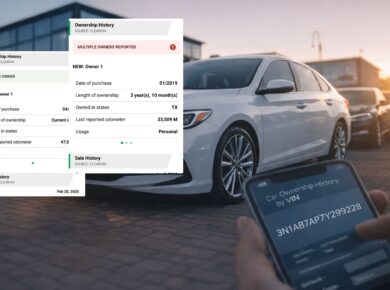
Title and ownership history — How many previous owners, how long each kept it, and which states it was registered in. Usage type (personal, fleet, rental, lease) is often included — which can significantly affect a vehicle’s real-world condition relative to its mileage.
Accident and damage records — Insurance claims, collision severity, airbag deployments, and structural damage reports. The VIN decode tells you the vehicle came with frontal and side airbags. The history report tells you whether they’ve deployed.
Odometer verification — Recorded mileage from DMV registrations and state inspections across the vehicle’s history. Inconsistencies between recorded readings flag potential rollback fraud.
Title brands — Salvage, rebuilt, flood, fire, hail, lemon law buyback, and junk designations — in any state, at any point in the vehicle’s history. A vehicle can be total-loss declared in one state and re-titled as clean in another. NMVTIS data tracks all of it.
Theft records — NICB database check for stolen vehicle reports and recovery status.
Open recalls — Active manufacturer safety recalls that haven’t been completed. The VIN decode identifies the model. The recall check confirms whether any safety issues remain unresolved.
Real example of why both matter:
A 2019 Honda Accord. VIN decode: 1.5L turbocharged inline-4, CVT transmission, sedan, U.S. assembly (Ohio plant). Exactly what the seller claimed.
ClearVin history report: two prior owners, one insurance claim for $9,200 in rear-end damage, one odometer reading 14,000 miles higher than the current odometer, active lien from a credit union.
The decode said “looks good.” The history said “investigate further.” Both pieces of information were necessary.
Decode and Check Any VIN with ClearVin
ClearVin provides two tools that together give you the complete picture:
Free VIN Decoder Instant breakdown of all 17 VIN characters — manufacturer, country of assembly, model year, engine, transmission, and more. No cost, no account required.
Full Vehicle History Report NMVTIS-authorized data covering title history, accidents, odometer records, ownership timeline, theft status, and open recalls.

6 comments
Hello! I just would like to give a huge thumbs up for the great info you have here on this post. I will be coming back to your blog for more soon.
Hi David, glad you liked this one. Looking forward to seeing you again on our website 🙂
I just could not leave your web site before suggesting that I actually loved the
standard info an individual provide to your visitors?
Is gonna be again steadily to check out new posts
I like this site very much, Its a really nice situation to read and get information.
Very nice post. I simply stumbled upon your blog and wished to mention that I have truly loved browsing your weblog posts. In any case I’ll be subscribing on your feed and I’m hoping you write again very soon!
Oh my goodness! Incredible article dude!
Comments are closed.