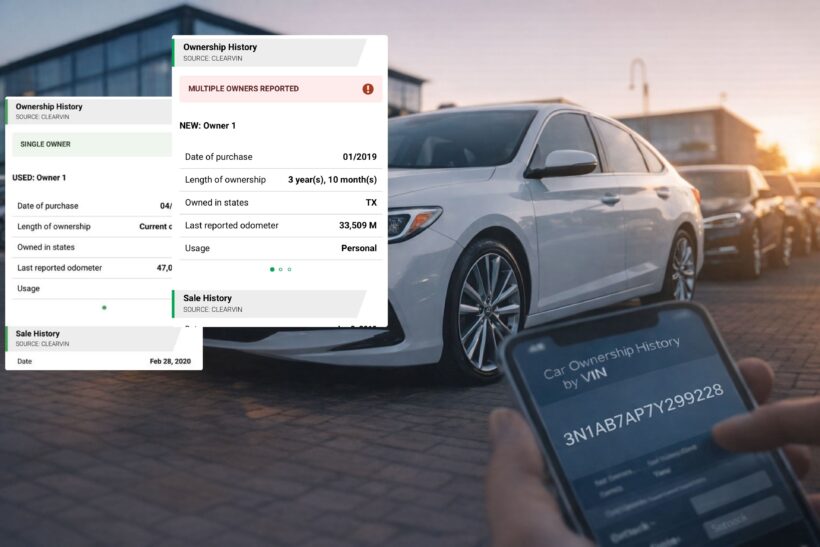
With 76% of Americans now driving used vehicles and the average used car costing over $25,000 in 2026, understanding a vehicle’s ownership history has never been more important. At ClearVin, we invite you to find out more about car ownership history and how to check a car’s previous owners.
Why Is Car Ownership History So Important?
Various VIN decoding services handle previous owner information differently. Some providers offer an estimated summary of how many owners a vehicle has had, while others don’t include ownership history at all. It’s worth noting that no legitimate service provider can disclose drivers’ private information due to the Driver’s Privacy Protection Act (DPPA). However, non-personal ownership data such as the number of owners, ownership duration, and registration states can be provided with varying levels of accuracy and detail depending on the provider’s data sources.
Red Flags in Ownership Patterns
If a car has changed hands many times in a short period, it may indicate hidden issues. A high number of previous owners often means the vehicle should be inspected carefully, preferably by a mechanic. We recommend visiting a car repair shop for a full diagnostic check.
Recent statistics paint a concerning picture: According to recent stats, approximately 2.45 million vehicles on U.S. roads have rolled-back odometers that is 14% increase from the previous year. Vehicles with odometer fraud lose an average of $3,300 in value, and buyers often face unexpected repair costs. This dramatic rise makes ownership verification more critical than ever.
Additionally, a long list of car owners can raise red flags about potential fraud. Illegal imports, document inconsistencies, or even involvement in schemes like “pink slip loans” may be revealed. That’s why a comprehensive VIN check should include lien, theft, title, damage history and car ownership history data. It will give you a full picture of the automobile sale reasons, registration history, and an overall background understanding of used cars from salvage auto auctions.
What You Can Find in Car Ownership History Records
The content of ownership records depends on the data provider. A good starting point is reviewing a VIN report sample to understand what’s included, especially when your goal is to find the owner by VIN number or review ownership history by license plate number.
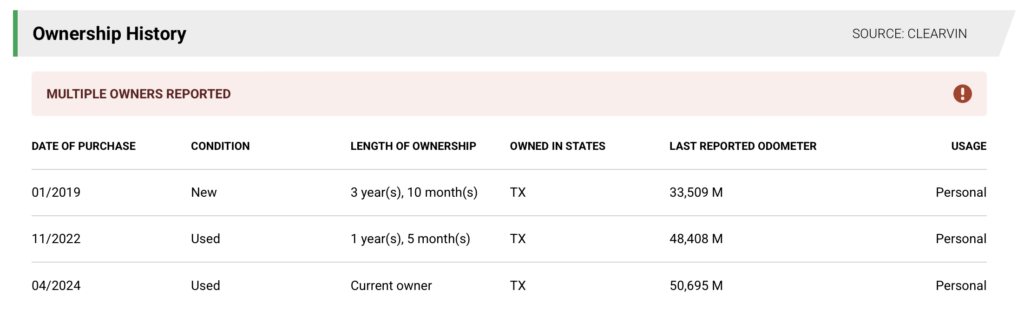
ClearVin provides relevant data in its ownership history section while respecting privacy laws. Although you won’t get personal information such as names or addresses, you’ll receive valuable insights, including:
Date of Purchase and Ownership Length
You can see how long each previous owner by VIN kept the vehicle. Frequent changes or very short ownership spans may point to unresolved issues. If you cannot track the owner by VIN, that may also signal an attempt to hide the vehicle’s past.
Understanding ownership duration is particularly important in today’s market where the average vehicle age has reached 12.5 years. A car that’s been through four owners in three years tells a very different story than one maintained by a single owner for a decade.
In What State It Was Owned
ClearVin includes data about the states in which a vehicle was registered. This helps you understand regional registration rules and spot suspicious changes in ownership across different states, sometimes used to conceal theft or fraud.
Geographic history matters more than ever following recent natural disasters. States like Florida, Texas, and Louisiana, which experienced major hurricanes, often see flood-damaged vehicles migrate to dry states like Arizona and Nevada to hide water damage history. Recent data shows Florida experienced a 20% increase in suspected odometer rollback cases, while states like Montana (+33%) and Tennessee (+30%) saw even larger jumps.
Estimated Miles Driven and Last Reported Odometer Readings
Knowing how far the car was driven under each owner adds more context. A high mileage count requires closer inspection of wear-prone components. This section of the VIN report helps assess how the vehicle was used and maintained.
The National Highway Traffic Safety Administration (NHTSA) estimates that more than 450,000 vehicles are sold annually with false odometer readings, costing American car buyers over $1 billion each year. With digital odometers now easier to manipulate using inexpensive devices available for as little as $50, verifying odometer consistency across ownership changes is essential.
Vehicle Usage Type and Its Impact
One of the most valuable pieces of information in the ownership history is the usage type designation—whether the vehicle was used for personal, lease, commercial, rental, or fleet purposes.
Understanding Usage Types:
Personal Use: The most desirable ownership type. Personal-use vehicles are typically better maintained and driven more carefully than commercial vehicles. Owners who purchase cars for personal use tend to keep up with maintenance and avoid excessive wear.
Lease: Leased vehicles are often well-maintained due to contractual service requirements, but may have higher mileage from unrestricted driving. Most leases require regular dealer maintenance, which can be a positive. However, lessees don’t own the vehicle long-term and may be less invested in its care.
Rental/Fleet: Rental cars and fleet vehicles represent higher risk. These vehicles:
- Experience multiple drivers with varying driving habits
- Often face aggressive driving and hard use
- May have deferred maintenance between rental periods
- Typically accumulate high mileage quickly
- Are retired from service and sold at relatively low ages
According to industry data, rental vehicles depreciate 15-25% faster than comparable personal-use vehicles due to perceived wear and tear. A three-year-old former rental car may have the wear equivalent of a five-year-old personal vehicle.
Commercial/Taxi/Rideshare: Commercial use represents the highest risk category:
- Extreme mileage accumulation (often 25,000-40,000+ miles annually)
- Constant stop-and-go driving in urban environments
- Minimal downtime for maintenance
- Heavy wear on transmission, brakes, and suspension
- Possible use in all weather conditions
Former taxi or rideshare vehicles may have 2-3 times the wear of a personal vehicle with the same mileage. A commercial vehicle with 60,000 miles may require the same repairs as a personal vehicle with 150,000 miles.
Government/Police: Government fleet vehicles, particularly police cars, face unique stress:
- Extended idling periods (hard on engines)
- High-performance driving and pursuit situations
- Installation and removal of equipment leaving holes/damage
- Possible accident history from pursuit or emergency response
When reviewing a ClearVin report, pay close attention to the Usage column in the Ownership History section:
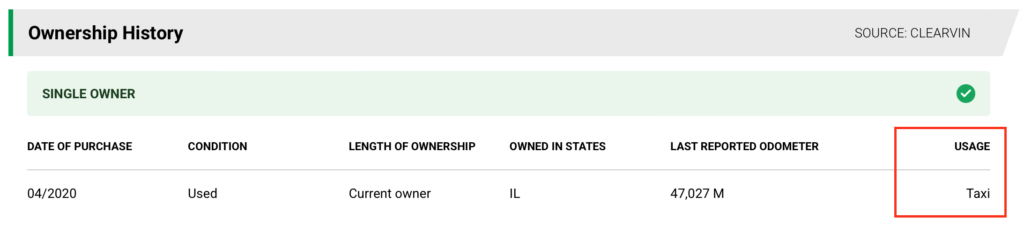
A vehicle that transitioned from lease or rental use to personal use may still carry the wear from its previous life, even if current mileage seems low.
Understanding the ClearVin Ownership History Report
What the Ownership History Block Shows
When you run a ClearVin vehicle history report, the Ownership History section provides a comprehensive timeline of the vehicle from its first registration to the present day. Here’s what you’ll see:
Multiple Owners Alert
If a vehicle has had more than one owner, ClearVin displays a prominent “MULTIPLE OWNERS REPORTED” alert at the top of the section. This immediate visual indicator helps you quickly identify vehicles that may need additional scrutiny.
Complete Registration Timeline
The ownership history table includes every recorded registration event, starting from the vehicle’s first sale. Each entry shows:
- Date of Purchase: When ownership changed hands
- Condition: Whether the vehicle was sold as New or Used
- Length of Ownership: How long each owner kept the vehicle (years and months)
- Owned in States: Which state(s) the vehicle was registered in
- Last Reported Odometer: Mileage reading at that point in time
- Usage: How the vehicle was used (Personal, Lease, Rental, Commercial, etc.)
DMV-Sourced Data
All ownership information in ClearVin reports is sourced from Department of Motor Vehicles (DMV) records across all 50 states. As an NMVTIS-approved data provider, ClearVin accesses:
- State motor vehicle registration databases
- Title transfer records
- Odometer disclosure statements
- Vehicle usage classifications
- Lien and loan records
This government-sourced data ensures accuracy and reliability. Unlike crowdsourced or self-reported information, DMV records are official legal documents that sellers must complete during title transfers.
Real-World Example
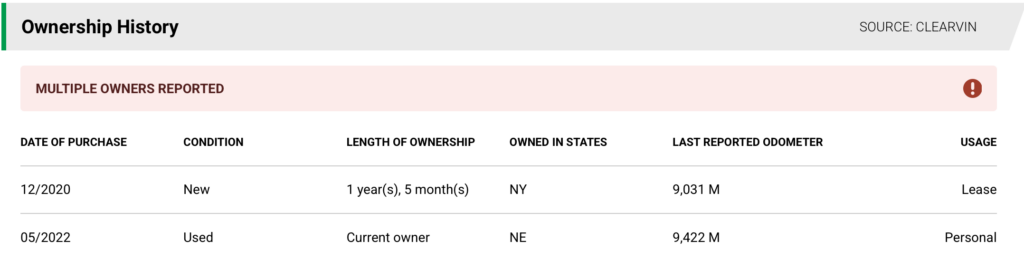
Looking at the sample report above, you can see:
- First owner (12/2020): Purchased new, kept for 1 year and 5 months in New York, odometer at 9,031 miles, used as a Lease
- Current owner (05/2022): Purchased used in Nebraska, odometer at 9,422 miles, used for Personal use
This tells you the vehicle was originally leased (likely returned to dealership after lease ended), then purchased by a private owner in a different state. The odometer increased only 391 miles in the transition period, which is consistent with the timeline.
Why This Level of Detail Matters
The ownership history block provides context that a simple owner count cannot. Two vehicles may both be “2-owner cars,” but their stories can be completely different:
Example A:
- Owner 1: Personal use, 8 years, same state
- Owner 2: Personal use, current owner, 2 years
Example B:
- Owner 1: Rental fleet, 2 years, Florida
- Owner 2: Personal use, current owner, 8 years
Example A suggests careful ownership and maintenance. Example B indicates a former rental car from a hurricane-prone state significantly higher risk despite the same number of owners.
The Usage designation is particularly valuable for assessing a vehicle’s true condition. A personal-use vehicle with 80,000 miles may be in better mechanical shape than a former taxi with 40,000 miles.
Privacy Laws and What You Can Access
The Driver’s Privacy Protection Act (DPPA)
Understanding what information you can legally access is important. The Driver’s Privacy Protection Act (DPPA), enacted in 1994, protects personal information in motor vehicle records.
What’s Protected:
- Previous owners’ names
- Home addresses
- Phone numbers
- Social Security numbers
- Driver’s license numbers
This federal law exists to prevent stalking, harassment, and identity theft. It was passed after high-profile cases where individuals used DMV records to locate and harm others.
Penalties for Violations: Unauthorized access to protected information carries serious consequences:
- Criminal fines under federal law
- Civil liability of $2,500 per violation minimum
- Possible state-level penalties
What You CAN Access: Despite privacy protections, vehicle ownership history reports can legally provide:
- Number of previous owners
- Length of each ownership period
- States where the vehicle was registered
- Odometer readings at registration
- Vehicle usage type
- General timeline of ownership changes
This information comes from non-personal data fields in DMV records that serve legitimate consumer protection purposes without revealing individual identities.
How You Can Determine the Previous Owners of a Car
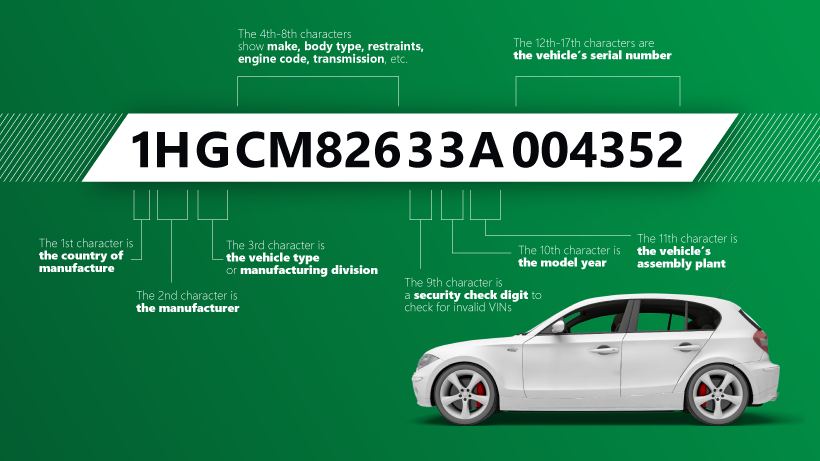
The VIN itself though unique and highly useful doesn’t contain personal ownership data. Still, there are ways to get useful details when trying to find car owner by VIN or determine who owns this car by VIN, while staying within legal bounds.
Check the Car Registration Documents
These typically include the name and address of the owner and may be found alongside insurance documents in the vehicle’s glove box. If you’re able to access these records legally, they’re a solid method for confirming owner by VIN data. However, keep in mind that possession of these documents doesn’t necessarily prove current ownership – verify the information matches the seller’s identification.
Visit a Motor Vehicle Department
You can also contact the DMV or a local motor vehicle department. While strict privacy laws apply, in certain cases, you may be able to find the owner of a car by VIN by submitting a request with supporting documentation and a valid reason.
Always check your local DMV’s privacy policies and request process. Some allow online applications using just the VIN and YMM (Year, Make, Model). Be aware that not all states will release the owner by VIN data, especially personal details. The DPPA allows only 14 specific “permissible uses” including:
- Government agency functions
- Court proceedings and litigation
- Licensed private investigators for specific purposes
- Insurance underwriting and claims
- Towing and vehicle impoundment
- Consumer consent
Casual buyer inquiries typically don’t qualify under DPPA permissible uses.
Use a VIN Check Service for Ownership Insights
To avoid delays and legal roadblocks, we recommend using a trusted service like ClearVin for a quick VIN owner lookup. Our system allows you to reveal the number of previous owners, estimated miles driven, ownership periods, and more – all without violating data privacy rules.
What Makes ClearVin Different:
NMVTIS-Approved Provider: ClearVin is an authorized data provider for the National Motor Vehicle Title Information System (NMVTIS) – the federal government’s official vehicle history database. This means our reports include:
- Data from all 50 state DMVs (99%+ coverage)
- Insurance company total loss records
- Salvage auction histories
- Junk and scrap yard reporting
- Title brand information from all states
Comprehensive and Current: Our ownership history data is updated regularly from government sources, ensuring you get the most recent and accurate information available.
Fast and Affordable:
- Instant reports delivered in seconds
- Both single and multi-report packages available ($5.80 per report for 5-pack)
- No subscription required
User-Friendly Format: The ownership history section presents complex data in an easy-to-read table format with clear visual alerts for multiple owners or concerning patterns.
Key Statistics for 2026 Buyers
Understanding current market conditions helps you evaluate whether ownership history concerns are normal or unusual:
The Used Car Market:
- 76% of Americans drive used vehicles (up from 70% in 2020)
- Average used car price: $25,000-$28,000
- Average new car price: $49,191 (out of reach for most buyers)
- Average vehicle age: 12.5 years (highest on record)
Fraud and Risk Factors:
- 2.45 million vehicles suspected of odometer rollback (14% increase year-over-year)
- $3,300 average loss per odometer fraud victim
- 450,000+ vehicles sold annually with false odometer readings
- $1 billion+ annual cost to car buyers from odometer fraud
Top States for Odometer Fraud:
These statistics underscore why thorough ownership verification matters, especially, when buying from private sellers or small dealerships in high-risk states.
Red Flags to Watch For
When reviewing a vehicle’s ownership history, certain patterns should raise immediate concerns:
Rapid Ownership Turnover: Three or more owners in less than three years suggests the vehicle has persistent problems. Each owner discovered issues and quickly sold to the next unsuspecting buyer.
Geographic Ping-Ponging: A vehicle registered in multiple states over a short period, especially moving from flood-prone states (FL, TX, LA) to dry states (AZ, NV, NM) may indicate title washing to hide damage history.
Ownership Gaps: Periods where the vehicle wasn’t registered could mean:
- Insurance total loss sitting in storage
- Major repairs that took extended time
- Repossession and auction
- Possible abandonment
Mileage Inconsistencies: If odometer readings don’t increase logically between ownership changes, or actually decrease, that’s clear evidence of fraud. Always compare reported mileage across the entire ownership timeline.
Usage Type Changes: A vehicle transitioning from commercial or rental use to personal use isn’t necessarily a deal-breaker, but you should adjust your expectations for condition and carefully inspect for excessive wear.
Final Thoughts
Understanding car ownership history through a VIN report is essential before buying a used vehicle. It helps you assess potential mechanical issues, spot fraud risks, and even explain why the current seller may want to part with the car.
Even if the car looks great, never rely solely on appearance or the seller’s words. A car ownership history check reveals how the car was used and maintained providing peace of mind for your purchase.
Protect your investment. Check the history. Buy with confidence.